
Rackspace vs AWS vs Azure: Which Cloud Platform Is Best in 2026?

Selecting a cloud hosting platform is no longer a simple decision between buying virtual servers or hosting physical hardware. Today, US businesses face a fundamental strategic choice: Do you build and manage your own cloud infrastructure on DIY hyperscalers, or do you leverage a managed multicloud specialist?
The cloud marketplace features two distinct paradigms:
- The Hyperscalers (AWS & Microsoft Azure): Global public cloud giants offering hundreds of unmanaged building-block services (IaaS/PaaS). They provide infinite scale and cutting-edge primitives, but place the entire burden of architecture, configuration, security, and 24/7 management on your in-house engineering team.
- The Managed Multicloud Specialist (Rackspace Technology): A pioneer in managed hosting (“Fanatical Support®”) that has evolved into a leading Managed Services Provider (MSP) and hybrid cloud provider. Rackspace offers high-touch operational management, dedicated bare-metal infrastructure, private cloud setups (OpenStack/VMware), as well as fully managed solutions on top of AWS and Azure.
According to US enterprise cloud benchmarks, over 78% of mid-market and enterprise organizations utilize multicloud or hybrid strategies. Understanding the trade-offs between Rackspace vs AWS vs Azure is critical to optimizing performance, ensuring regulatory compliance, and controlling operational costs.
1. Architectural Paradigms: Unmanaged DIY vs. Fully Managed Hybrid
To understand how AWS, Azure, and Rackspace compare, IT leaders must look beyond basic server specs and evaluate their fundamental operational models:
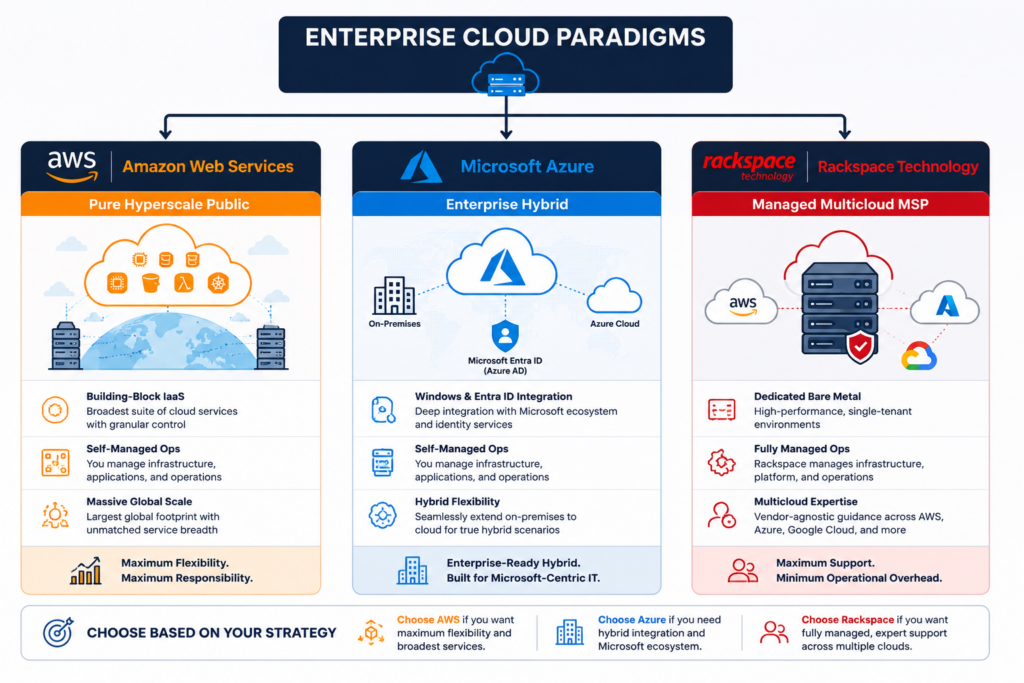
A. Amazon Web Services (AWS): The Hyperscale Building-Block Model
AWS is engineered for self-sufficiency and raw architectural freedom. Amazon provides modular primitives (EC2, S3, RDS, Lambda) that act as LEGO bricks. Developers can build virtually any system, but AWS will not configure your firewall, optimize your SQL queries, or fix your broken CI/CD pipeline unless you purchase expensive Enterprise Support tiers or hire specialized third-party consultants.
B. Microsoft Azure: The Enterprise Ecosystem & Hybrid Leader
Azure provides hyperscale IaaS and PaaS similar to AWS, but is deeply integrated into the Microsoft enterprise software footprint. Azure excels in hybrid cloud topologies through Azure Arc and Azure Stack, allowing businesses to manage on-premises Windows servers and cloud instances seamlessly using a unified identity layer (Microsoft Entra ID / Active Directory).
C. Rackspace Technology: The Managed & Custom Infrastructure Model
Unlike AWS and Azure, which primarily operate massive public cloud datacenters, Rackspace focuses on eliminating operational burden. Rackspace offers three primary deployment tracks:
- Private Cloud & Bare Metal: Dedicated physical hardware and private OpenStack/VMware environments tailored for single-tenant compliance and predictable high IOPS performance.
- Managed AWS Services: Architecting, migrating, securing, and managing your AWS infrastructure so your team doesn’t have to hire 24/7 cloud ops engineers.
- Managed Azure Services: Co-managed or fully managed Azure environments backed by certified Rackspace Azure architects.
2. Feature & Service Comparison Matrix
Below is a detailed side-by-side technical breakdown of Amazon Web Services, Microsoft Azure, and Rackspace Technology across core enterprise requirements:
| Feature / Category | Amazon Web Services (AWS) | Microsoft Azure | Rackspace Technology |
|---|---|---|---|
| Primary Cloud Model | Hyperscale Public IaaS / PaaS | Hyperscale Public & Hybrid Cloud | Managed Multicloud, Private & Public MSP |
| Target Audience | Startups, Scale-ups, Global Enterprise | Enterprise Microsoft Shops, Hybrid IT | Mid-Market, Enterprise needing 24/7 Ops |
| Compute Options | EC2 (VMs), Fargate, Lightsail | Azure VMs, App Services | Bare Metal, Private Cloud, Managed VMs |
| Object & File Storage | S3, EBS, EFS | Azure Blob, Disk Storage, Files | SAN, NAS, Object Storage, Managed Cloud |
| Database Offerings | RDS, Aurora, DynamoDB | Azure SQL, Cosmos DB, MariaDB | Managed Databases (SQL, NoSQL, Oracle) |
| Management Burden | High (Self-Managed / DIY) | High (Self-Managed / DIY) | Low (Fully Managed / Fanatical Experience) |
| Hybrid Cloud | AWS Outposts, EKS Anywhere | Azure Arc, Azure Stack | Custom VMware, Hosted OpenStack, Multi-Cloud |
| Licensing Advantages | BYOL (Bring Your Own License) | Azure Hybrid Benefit (Windows/SQL) | Flexible Licensing & Managed Splitting |
| Support Model | Ticket-based / Tiered Paid Support | Enterprise Agreement (EA) / Tiered | Included 24/7/365 Hands-On Engineering |
| Uptime Guarantee | 99.99% for multi-AZ EC2 | 99.99% for multi-region | Up to 100% SLA on Dedicated Hosting |
3. Deep-Dive Provider Analysis
Amazon Web Services (AWS): Unrivaled Breadth & Hyperscale Innovation
AWS remains the market leader in cloud infrastructure, controlling over 31% of the global cloud market.
- Key Strengths:
- Service Ecosystem: With over 200 fully featured services, AWS offers cutting-edge capabilities in serverless compute (AWS Lambda), container orchestration (Amazon EKS), AI/ML (Amazon SageMaker), and edge computing.
- Global Footprint: AWS operates 108 Availability Zones across 34 geographic regions, providing unmatched global availability and ultra-low latency for US traffic.
- Developer Community: The largest ecosystem of third-party tooling, Terraform modules, and community documentation.
- Key Challenges:
- Complexity & Choice Paralysis: Configuring IAM policies, VPC peering, and security groups requires dedicated AWS Certified Solutions Architects.
- Billing Surprises: Egress data transfer fees and unoptimized storage can quickly balloon monthly invoices.
Microsoft Azure: The Enterprise Standard for Hybrid Workloads
Microsoft Azure holds approximately 25% of the cloud market and is the premier choice for Fortune 500 enterprises embedded in the Microsoft ecosystem.
- Key Strengths:
- Microsoft Ecosystem Synergy: Seamless single sign-on (SSO) via Microsoft Entra ID (formerly Azure AD), unified licensing with Microsoft 365, and native integration with Visual Studio and GitHub.
- Azure Hybrid Benefit: Allows US enterprises to reuse existing Windows Server and SQL Server licenses on Azure, yielding up to 40% to 85% cost savings over AWS.
- AI Leadership: First-party integration with OpenAI models via Azure OpenAI Service.
- Key Challenges:
- Management Overhead: Like AWS, Azure expects your internal staff to manage daily administrative patches, backups, and network troubleshooting.
- Console Usability: Some DevOps teams find the Azure Portal and Resource Manager (ARM) templates more cumbersome than AWS IAM or Infrastructure-as-Code setups.
Rackspace Technology: Eliminating Operational Overhead with Managed Multicloud
Rackspace occupies a unique strategic position in the US cloud ecosystem. Rather than competing directly as a pure hyperscale builder, Rackspace provides custom infrastructure and managed operational services.
- Key Strengths:
- Hands-On Operational Management: Rackspace provides 24/7/365 access to cloud engineers who perform proactive monitoring, OS patching, database tuning, and architecture reviews.
- Dedicated Bare Metal & Private Cloud: For workloads requiring extreme performance, isolation, or strict regulatory compliance, Rackspace provides non-virtualized bare-metal servers and private OpenStack/VMware clusters.
- Multicloud Unification: Rackspace can manage your AWS and Azure environments under a single unified SLA, providing cross-cloud governance and financial optimization (FinOps).
- Key Challenges:
- Higher Baseline Entry Costs: Managed services include a management fee overlay, making Rackspace less suited for tiny startups seeking $5/month virtual servers.
- Fewer Proprietary PaaS Primitives: Does not build standalone proprietary AI/ML clouds; instead relies on managing AWS/Azure AI services or private deployments.
4. The Hidden Cost: In-House DevOps Overhead vs. Managed MSP Model
When evaluating Rackspace vs AWS vs Azure, IT decision-makers often make the mistake of comparing server hourly instance rates alone. However, the cloud infrastructure bill represents only a fraction of Total Cost of Ownership (TCO).
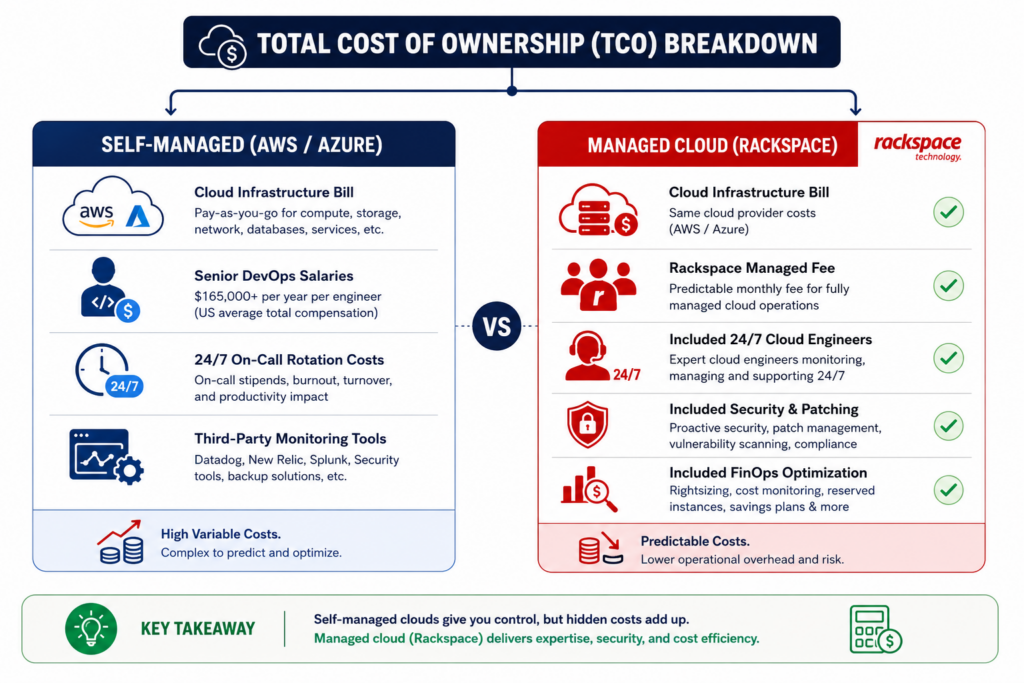
The US Engineering Talent Shortage
In the United States, hiring senior cloud engineers and DevOps specialists is increasingly expensive:
- Average US Senior Cloud Engineer Salary: $160,000 – $195,000/year (plus benefits, equity, and overhead).
- Maintaining a true 24/7/365 incident response team requires a minimum of 4 to 5 full-time engineers.
If your business hosts infrastructure directly on AWS or Azure without dedicated in-house DevOps expertise, system outages, security misconfigurations, and delayed software releases can cost hundreds of thousands of dollars.
How Rackspace Shifts the Equation: By partnering with Rackspace for Managed AWS or Managed Azure, mid-market businesses offload 24/7 infrastructure management to Rackspace’s engineering team, effectively gaining an enterprise DevOps team at a fraction of the cost of internal headcount.
5. Pricing Models & Financial Optimization (FinOps)
Navigating cloud pricing requires understanding how each provider structures commitments and billing:
A. AWS Pricing Dynamics
- On-Demand: Pay per second for compute. Highest flexibility, highest price.
- Savings Plans & Reserved Instances (RIs): Commit to 1-year or 3-year usage terms for up to 72% discounts.
- Data Egress Fees: AWS charges for data transferred out of its network to the public internet ($0.09/GB after initial tier).
B. Azure Pricing Dynamics
- Pay-As-You-Go: Standard hourly rate.
- Reserved Virtual Machine Instances: 1-year or 3-year commitments yielding up to 72% savings.
- Azure Hybrid Benefit (AHB): Significant savings for existing Microsoft software license holders.
C. Rackspace Pricing Dynamics
- Managed Public Cloud (AWS/Azure): Cloud resource consumption cost + flat or percentage-based managed service fee.
- Dedicated Hosting & Private Cloud: Fixed monthly pricing per server/host, eliminating unpredictable egress or compute utility spikes.
For industry standards on managing multi-cloud cost optimization, consult resources on the FinOps Foundation Framework.
6. Security, Compliance, and Shared Responsibility Models
US businesses operating in healthcare, finance, e-commerce, and government must maintain strict compliance standards (HIPAA, PCI-DSS, SOC 2, FedRAMP, NIST).
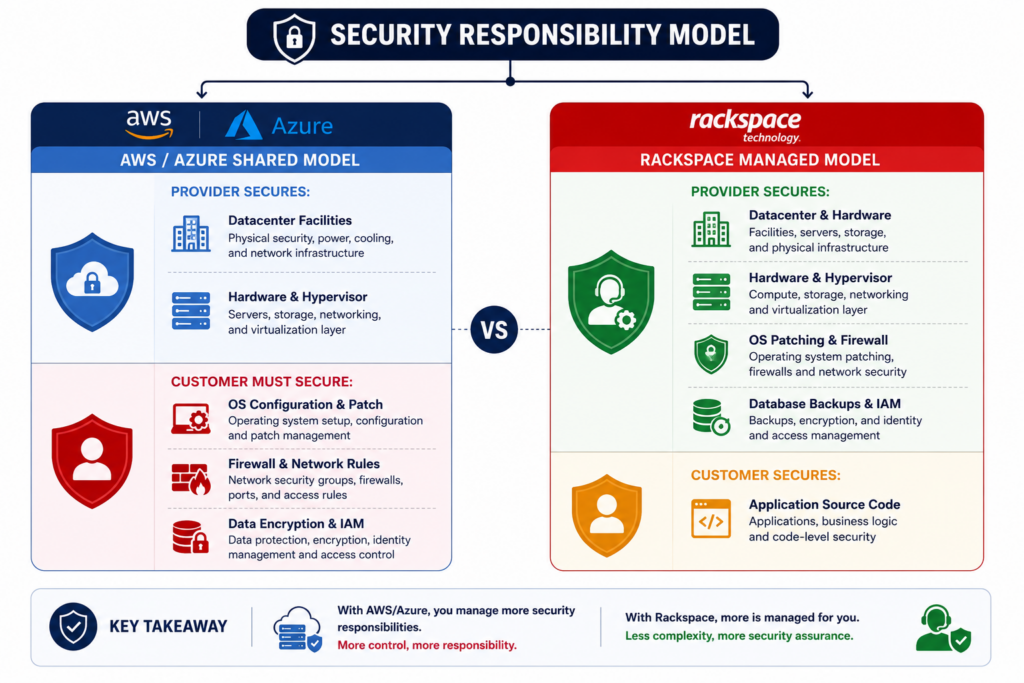
- AWS & Azure (Shared Responsibility): The hyperscaler secures the physical datacenter, host hypervisor, and network facility. You are responsible for securing everything inside the VM, including OS patches, firewall rules, data encryption, and IAM permissions.
- Rackspace Technology (Managed Responsibility): Rackspace takes ownership of OS maintenance, anti-virus, network intrusion detection, database backups, and compliance auditing assistance, drastically simplifying SOC 2 and HIPAA compliance audits for US companies.
For cloud compliance benchmarks, refer to the guidelines published by the Cloud Security Alliance (CSA).
7. Decision Matrix: Which Cloud Platform Fits Your US Business?
To determine whether Azure, AWS, or Rackspace is the optimal choice for your organization, follow this strategic decision framework:
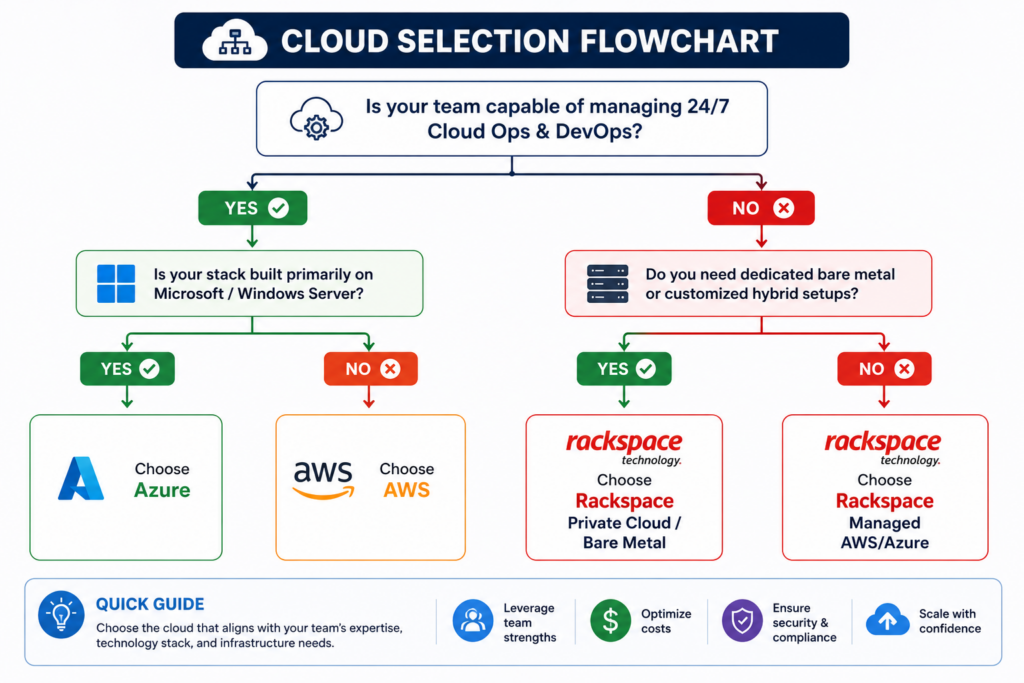
Summary Sourcing Recommendations
- Choose Amazon Web Services (AWS) if:
- You have a mature, dedicated in-house DevOps engineering team.
- You are building cloud-native applications using microservices, serverless, and advanced open-source stacks.
- You require access to the widest variety of specialized cloud services globally.
- Choose Microsoft Azure if:
- Your enterprise relies heavily on Microsoft 365, Active Directory (Entra ID), SQL Server, and Windows Server.
- You hold existing Microsoft Enterprise Agreements (EA) and want to maximize cost savings via Azure Hybrid Benefit.
- You need robust hybrid cloud connectivity between local datacenters and the cloud using Azure Arc.
- Choose Rackspace Technology if:
- Your IT organization lacks the budget or headcount to build a 24/7/365 in-house DevOps and cloud ops team.
- You need single-tenant dedicated bare-metal servers or custom private cloud environments for extreme compliance or performance.
- You want to run on AWS or Azure, but want a trusted partner to handle architectural design, migration, security, and continuous maintenance.
Conclusion & Strategic Next Steps
There is no single “winner” in the battle of Azure vs. AWS vs. Rackspace. Instead, the right platform depends on your operational maturity, software stack, and internal engineering capabilities:
- AWS remains the undisputed king of hyperscale flexibility and developer ecosystem.
- Azure is the enterprise powerhouse for Microsoft environments and hybrid topologies.
- Rackspace Technology bridges the skills gap by offering fully managed services on public cloud or custom dedicated bare-metal infrastructure.
For US IT leaders, evaluating cloud infrastructure is an ongoing process. To maximize ROI, consider performing a comprehensive Cloud Readiness Audit to assess your application architecture, licensing assets, and operational requirements before executing your next cloud migration.
